
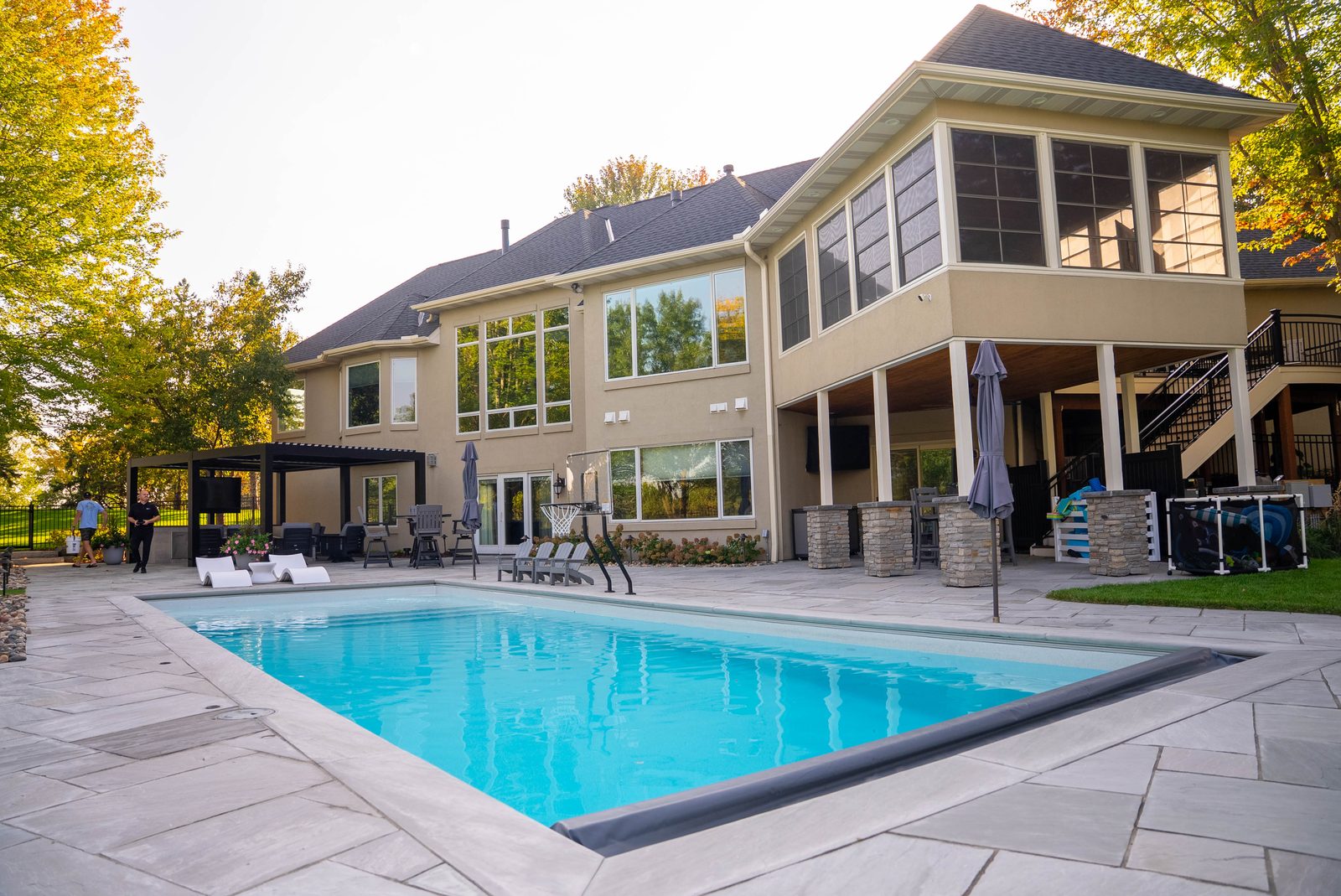
A pool is only as good as the space around it. That is not a slogan for us; it is the thing we hear from homeowners who built a pool first and the yard later, and it is why we design the two together. This guide is about the second half: the deck, the plantings, the privacy, the shade, the wind, the lighting and the small decisions that make a Minnesota pool backyard a place you live in from May to October instead of a hole in the lawn you look at from the kitchen.
Everything here is written for the Twin Cities: USDA zone 4 winters, a short season, mosquitoes, and a summer wind that mostly comes out of the southwest.
Start with the deck, not the plants
The deck sets the size, the feel and the budget of a pool backyard, so it comes first.
Size it for how you live. A row of loungers needs about 7 feet of depth along the long side. A dining table for six wants a 12 by 14 foot area that is not in the splash zone. An outdoor kitchen run needs about 8 feet of depth plus room to stand behind the person cooking. A typical pool deck runs 500 to 1,200 square feet, and the difference between the two ends of that range is mostly whether the yard also has a lounge, a kitchen or a cabana.
Pick a surface that survives winter. Our two go-to materials are large-format concrete pavers and porcelain pavers. Both flex with freeze-thaw instead of cracking, both can be lifted and reset if a section ever settles, and both come in light colors that stay cooler underfoot in July. Our concrete vs. paver guide and porcelain paver guide go deeper. The Sustainable Modern in Shakopee uses a wide porcelain deck; Woodbury Poolside and Poolside on the Hill use large-format pavers.
Plan the edges. The 2 to 3 feet beside the water is the splash zone. Mulch there ends up in the pool; river rock, a turf strip or planted beds set back from the coping stay put. The Backyard Barn in Stillwater uses a strip of turf along the deck for exactly that reason, plus bare feet.
What to plant around a pool in Minnesota
The rules are simple: hardy to zone 4, low litter, no thorns, and good from May through October because that is when you are out there.
Grasses (movement, privacy, almost no litter)
- Feather reed grass ‘Karl Foerster’: upright, 4 to 5 feet, the classic poolside grass; zone 4.
- Little bluestem: native, blue-green turning copper in fall, 2 to 3 feet; zone 3.
- Prairie dropseed: fine, fountain-shaped, 2 feet, smells like popcorn in late summer; zone 3.
- Switchgrass ‘Northwind’: strictly upright, 5 feet, a living privacy screen; zone 4.
Shrubs (structure and bloom)
- Panicle hydrangeas (‘Limelight’, ‘Little Lime’, ‘Bobo’): the most reliable big bloom in Minnesota, July to frost; zone 3.
- Spirea and ninebark: tough, colorful foliage, easy to keep in scale; zone 3.
- Dwarf Korean lilac: May fragrance, compact; zone 3.
- Potentilla: blooms all summer, shrugs off winter; zone 2.
- Red twig dogwood: winter color after the pool is closed; zone 2.
Perennials (sun)
- Catmint ‘Walker’s Low’: blue haze from June on, loves heat off the deck; zone 3.
- Daylily, sedum ‘Autumn Joy’, coneflower, black-eyed Susan: the Minnesota workhorses; zone 3.
- Russian sage and salvia ‘May Night’: silver and purple against pavers; zone 4.
- Allium: purple globes in June over the grasses; zone 4.
Perennials (shade side)
- Hosta, coral bells, astilbe: for the north side of a cabana or under existing trees; zone 3 to 4.
Screening
- Arborvitae ‘Technito’, ‘North Pole’ or ‘Holmstrup’: narrow, upright, 10 to 15 feet, the fastest route to privacy; zone 3.
- Upright junipers: tolerate wind and sun better than arborvitae on an exposed lot; zone 3 to 4.
- Boxwood (‘Green Velvet’, ‘Green Mountain’): formal edging, but it can winter-burn in an open, windy spot. Our plant warranty excludes winter burn on boxwood and arborvitae for that reason, so we site them carefully and burlap evergreens their first winter.
Lavender, many roses and most of the Mediterranean-looking plants in pool magazines are zone 5 or warmer, or they are thorny. We leave them out.
What to keep away from the water
Some plants are wrong next to a pool no matter how hardy they are.
- Litter trees: cottonwood, silver maple, boxelder, willow and river birch drop seed, catkins and leaves all season. Oaks drop acorns and tannin-staining leaves. Keep them 25 to 30 feet or more from the water, and never over the deck.
- Fruit trees: crabapples, cherries and serviceberries feed birds, and birds over a pool are a cleaning problem.
- Needles: spruce and pine within reach of the deck shed needles into the skimmer. Fine for a windbreak at the lot line, wrong at the coping.
- Thorns: barberry, hawthorn and shrub roses have no business at a bare-foot edge.
- Bee magnets at the deck: linden trees and masses of flowering plants right beside the water put bees and swimmers in the same place. Pollinator plantings belong in the yard, not at the coping.
- Aggressive roots: willows, poplars and silver maples again. Roots follow water, and the pool plumbing is water.
Existing trees get evaluated one at a time during design. Still Waters in Mahtomedi sits among the lot’s mature trees rather than in a clearing; working with the trees you have is usually the better answer than cutting them.
Sun, wind and shade
Sun. The deck goes on the sunny side of the pool, usually south or west of the water, so loungers get the afternoon and the water warms. A pool tucked on the north side of a two-story house is in shadow by 4 pm in September.
Wind. Our summer wind is mostly southwest. Wind cools the water, blows debris in and makes a 75-degree afternoon feel like 65 on a wet body. A fence section, a planted screen or a cabana on the southwest side takes the edge off without blocking the sun.
Shade on demand. The pergola is the most-used structure in our pool backyards because it is adjustable: open louvers at noon, closed at 4 pm, closed in rain. Life on the Fairway and Woodbury Poolside both pair a louvered aluminum pergola with the pool deck; our pergola cost guide covers the options. A cabana adds a changing room and a shaded bar and, on an open lot, a wind block.
Privacy without a wall
Screen the sightlines that matter instead of fencing the world out. From the water, the view that bothers people is usually one neighbor’s second-story window and one side yard. A row of upright arborvitae or junipers there, a slatted screen beside the cabana, and layered plantings in front of the pool fence handle it while the south and west sides stay open. The pool fence itself is required by code (our pool rules guide covers the details by city); black aluminum disappears behind plantings and keeps the view, which is why it is on most of the pools we build.
Fire, lighting and the shoulder seasons
A fire feature is what makes the pool deck usable in May and September. A linear gas fire table beside the loungers, as at The Sustainable Modern and Woodbury Poolside, warms the evening without smoke drifting over the water. Low-voltage lighting on the steps, under the pergola and in the beds makes the deck a room after dark, gates included.
Heater and auto cover: the season question
Unheated, a Minnesota pool is roughly Memorial Day to Labor Day. A gas heater or heat pump stretches that into spring and fall, and an automatic cover is what makes the heat affordable, because an uncovered pool loses much of its heat to evaporation overnight. The Minnesota energy code requires a vapor-retardant cover on heated pools anyway, so the cover is not optional on most of the pools we build; the question is only whether it is automatic. Plan the cover housing into the deck design from the start. It affects the coping, the deck layout at one end of the pool, and where the loungers go.
Putting it together
The pool backyards on this site were designed as one plan: the pool, the deck sized for how the family lives, the fence and gates, the shade, the fire, the screening, the plantings and the lighting, built in order by one crew. Our pool cost guide explains why we recommend budgeting for the space around the pool from the beginning, the pool page shows the three fiberglass shells we install most often through our sister company Blaiser Pools, and the plunge pools page covers the small-footprint option.
If you are picturing a pool but not sure what the yard around it should be, send us a few photos and we will put together a free idea board for your space, plantings included.